
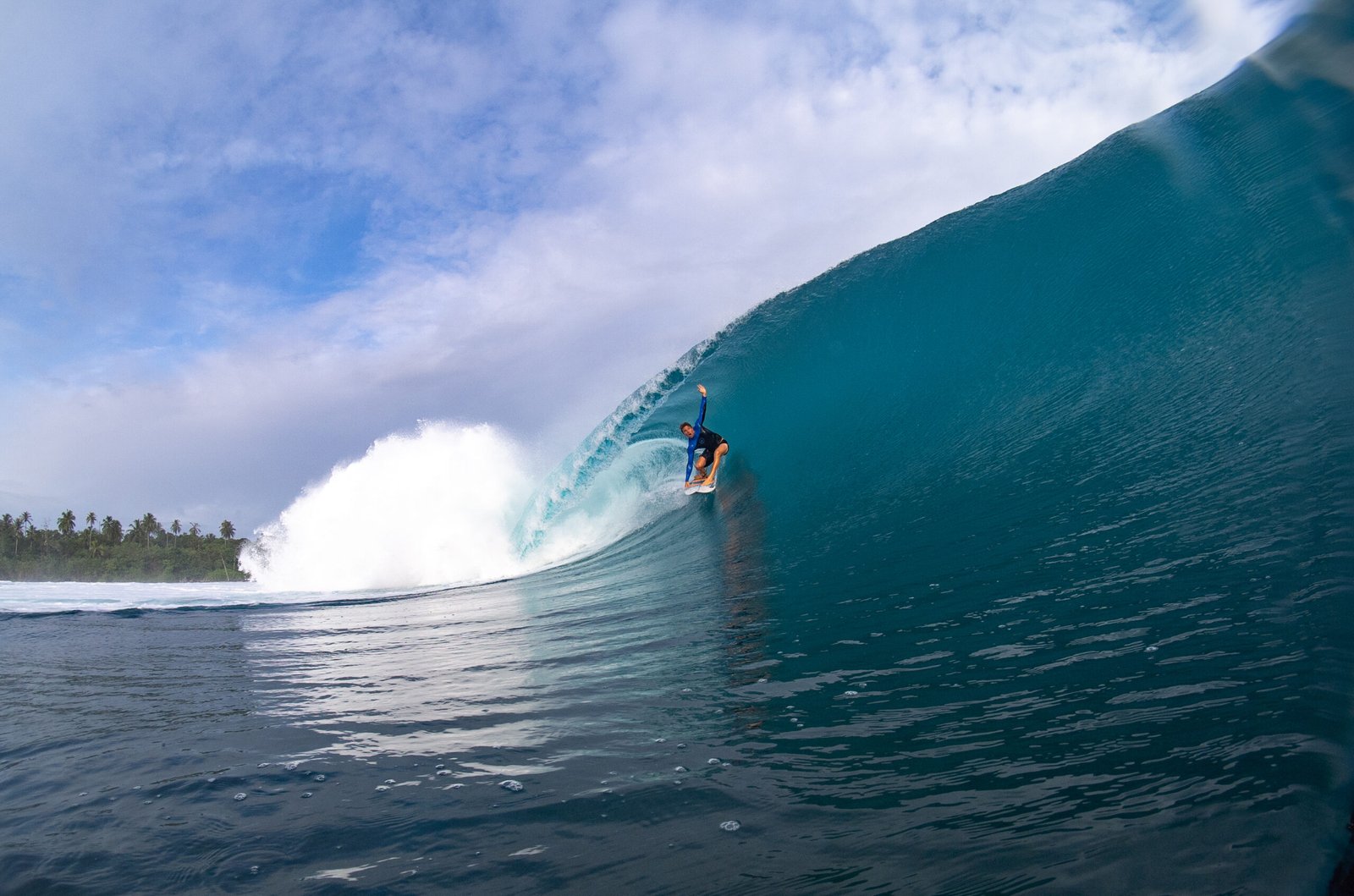
Every year, surfers travel from all over the world to Indonesia.
They come for the waves, of course. The long lefts, hollow reef passes, warm water, and the possibility that somewhere, on some island, the best wave of their life is about to arrive. For many visiting surfers, the trip has been planned for months. Sometimes years. Flights have been booked, boards carefully packed, forecasts watched from the other side of the world.
Then you finally arrive. The swell is here. The tide is right. And so is everyone else. This is where surf etiquette matters.
The basic rules of surfing are more or less universal. Do not drop in. Do not snake people. Do not paddle straight through the path of a surfer riding a wave. But traveling to surf brings another layer to those rules. Because while this may be the surf trip of your life, for someone else, it is home.
Table of Contents
Learn How the Lineup Works Before You Paddle Straight to the Peak
Every lineup has its distinct rhythm. Some work with a clear rotation. Others have several take-off zones. At certain waves, the deepest surfer has priority. At others, positioning changes constantly with the sets.
When you arrive at a surf spot you have never surfed before, take a few minutes to watch. See where people are sitting. Watch where the waves actually break. Notice how surfers move through the lineup and where they paddle back out.
This is useful for safety, but it also tells you something about the social rhythm of the break. You do not need to paddle straight to the deepest part of the peak the moment you enter the water. There will be another wave.
Do Not Drop In
This is the simplest rule in surfing and somehow still the one that causes the most problems.
The surfer closest to the breaking part of the wave has priority. If someone is already up and riding, the wave is theirs. Do not go. Even if you think you can make the section. Even if the wave is perfect. Even if you have been waiting for twenty minutes.
A good wave is not worth ruining someone else’s ride or causing a collision. At busy waves, things can happen quickly. Sometimes two surfers paddle for the same wave without seeing each other. Sometimes someone takes off deeper than expected. If you make a mistake, kick out safely and apologize.
Most surfers understand an honest mistake. Repeatedly doing the same thing is no longer a mistake.
Do Not Snake the Lineup
Priority is not only about who is sitting deepest when a wave arrives.
If another surfer has been waiting patiently and you repeatedly paddle around them to take the inside position, you are not being clever. You are snaking.
Busy lineups can make people competitive. Everyone wants a good wave, especially after traveling a long way to get there. But a lineup works better when surfers pay attention to who has been waiting and allow some rotation to occur.
You will usually get your waves. And when you do, they tend to feel better when you have not spent the previous twenty minutes making everyone around you angry.
One Surfer, One Wave
At most surf spots, one surfer has priority on a wave. That means if someone is already riding, do not take off farther down the line simply because there is space in front of you. This is especially important on fast reef breaks, where another surfer appearing unexpectedly on the wave can create a dangerous situation.
There are exceptions. Some waves are commonly shared, particularly softer waves or certain long point breaks where local lineup culture allows it. But do not assume. If you do not know whether a wave is regularly shared, stick to one surfer per wave.
Know Your Ability
Indonesia has waves for almost every level of surfer. It also has waves that are far more serious than they look from shore. A perfect reef break can appear surprisingly manageable from a distance. Then you paddle out and realize the wave is faster, shallower, and more powerful than you expected.
Choosing a wave that fits your ability is part of surf etiquette.
If you cannot control your board, make the take-off, or get out of the way safely, you are not only putting yourself at risk. You may be putting other surfers at risk too.
There is no shame in sitting out a session.
There is always another wave somewhere.
Hold On to Your Board
Losing your board happens. But repeatedly throwing it away whenever a wave approaches is dangerous, particularly in a crowded lineup.
A surfboard moving through whitewater on the end of a leash can hit someone several meters behind you. If you are learning, give other surfers space. Do not paddle into the middle of a crowded peak if you are not yet able to control your board. And if you are surfing without a leash, make sure you have the ability and awareness to do so safely.
Your equipment is your responsibility.
Do Not Paddle Straight Through the Lineup
When you are paddling back out, try not to paddle directly into the path of the surfer riding the wave. Sometimes this means paddling toward the whitewater rather than toward the open face. Yes, you may take the wave on the head. That is often better than forcing the surfer on the wave to change their line or risk a collision. Find out where the channel is, if there is one, and pay attention to how other surfers get back to the lineup.
A few seconds of awareness can prevent a very bad situation.
Respect Local Surfers
Localism exists in surfing all over the world, and every surf community is different. But respect does not need to be complicated. Say hello. Be patient. Do not arrive at a new break and behave as though you are entitled to every set wave because you paid a lot of money to get there.
For visiting surfers, it is worth remembering that access to many of Indonesia’s waves has changed dramatically over the years. A wave that was once surfed mostly by people from the surrounding community may now have surf camps, resorts, boats, photographers, and dozens of visiting surfers arriving every day.
Surf tourism can create opportunities. It can also change a place very quickly. You do not need to understand every part of that history before paddling out. But you should understand that you are entering a place that existed before you arrived.
Your Surf Trip Does Not Give You Priority
You may have flown halfway around the world. You may only have seven days. You may have spent thousands on flights, accommodation, boats, and boards. None of that gives you priority in the lineup. The ocean does not know how much your trip costs. Neither does the surfer who has been patiently waiting for their turn.
One of the easiest ways to have a better surf trip is to let go of the feeling that every single session needs to deliver. Some days you will get the wave of your life. Some days you will get three mediocre waves and a sunburn. That is surfing too.
Be Careful With Surf Photography and Social Media
Surf travel has changed.
A wave can go from relatively unknown to internationally recognized very quickly. One photograph, video, or location tag can reach thousands of people before you have even dried your boardshorts.
Not every surf spot is a secret. Many of Indonesia’s waves have been documented for decades.
But that does not mean every location needs to be geotagged, mapped, or explained in detail.
Before posting, consider the place.
If local surfers or the people who took you there ask you not to share a location, respect that.
There is a difference between sharing your surf trip and publishing directions.
Respect the Place Beyond the Lineup
Good surf etiquette does not end when you reach the beach.
Indonesia’s surf destinations are also villages, islands, fishing communities, and people’s homes. Take your rubbish with you. Use refillable water bottles where possible. Be mindful of where you park. Dress appropriately when moving through communities away from the beach. Learn a few words of Indonesian.
Terima kasih goes a long way. So does being curious about the place you are visiting beyond the waves. You came to surf, but you are still traveling through someone else’s home.
Support the People Who Make Your Surf Trip Possible
Surfing in Indonesia is supported by an enormous network of people. Boat captains. Drivers. Surf guides. Photographers. Board repairers. Instructors. Guesthouse owners. Cooks. Fishermen who know the coastline better than any forecast ever will.
Where possible, support local businesses and local people. Hire local guides. Pay fairly. Buy photographs from the photographer who spent hours swimming in the impact zone. Get your board repaired by the person whose ding shop you pass every morning. A surf trip is rarely something you experience entirely on your own.
Respect Goes Both Ways
Surf etiquette should not be used as an excuse for aggression, intimidation, or dangerous behavior. Being local does not automatically make someone right in every situation, just as being a visitor does not automatically make someone disrespectful.
Most lineups are more complicated than that. People make mistakes. Surfers misunderstand each other. Crowded waves create frustration. But shouting at or threatening people, or deliberately putting someone in danger, rarely improves anything. Good surf culture depends on mutual respect.
Leave the Entitlement on Shore
Indonesia has given the surfing world an extraordinary amount. Its waves have appeared in films, magazines, advertisements, and many stories. Entire surf careers and businesses have been built around traveling here.
For visiting surfers, the best way to show appreciation is not complicated. Wait your turn. Know your ability. Respect the people around you. Pay attention to where you are. And remember that the best surfer in the lineup is not always the person getting the most waves. Sometimes, it is simply the person everyone is happy to share the ocean with.