
You have booked the flights. The forecast is still too far away to mean anything, but you are checking it anyway. Now comes one of the questions that almost every surf trip brings.
Do you bring your own boards?
For some surfers, the answer is obvious. Of course you do. Your boards are familiar, dialed in, and probably chosen specifically for the kind of waves you are hoping to surf. For others, dragging a coffin bag through airports, paying oversized baggage fees, and spending the first ten minutes at every luggage carousel wondering whether the boards survived the flight is enough to make renting look very appealing.
In Indonesia, both options can work. But where you are going matters.
Renting a surfboard in Bali is one thing. Trying to find the right step-up after arriving in a remote place is another.
Here is what to think about before you pack the board bag.
Table of Contents
Bring Your Own Boards If You Know What You Want to Surf
If the main purpose of your trip is surfing, bringing your own boards usually makes sense. You already know how they paddle. You know how they feel under your feet. You know which one you want when the waves are small and which one comes out when the swell arrives. That familiarity matters.
Indonesia has plenty of waves where hesitation is not particularly useful. On a fast reef break, you probably do not want your first thought during the take-off to be whether the unfamiliar rental board under your feet is going to hold. This becomes even more important for experienced surfers traveling specifically for quality waves.
If you are heading to the Mentawai Islands, Nias, the Banyak Islands, or another remote surf destination, your board selection is part of the trip. Bring the boards you want to surf.
Renting Makes Sense If Surfing Is Only Part of the Trip
Not every trip to Indonesia is built entirely around waves.
Maybe you are spending a week in Bali, traveling through Java, visiting family, diving, hiking, or moving between several islands. You want to surf when the opportunity comes, but you do not necessarily want a board bag following you everywhere. In that case, renting can make life much easier.
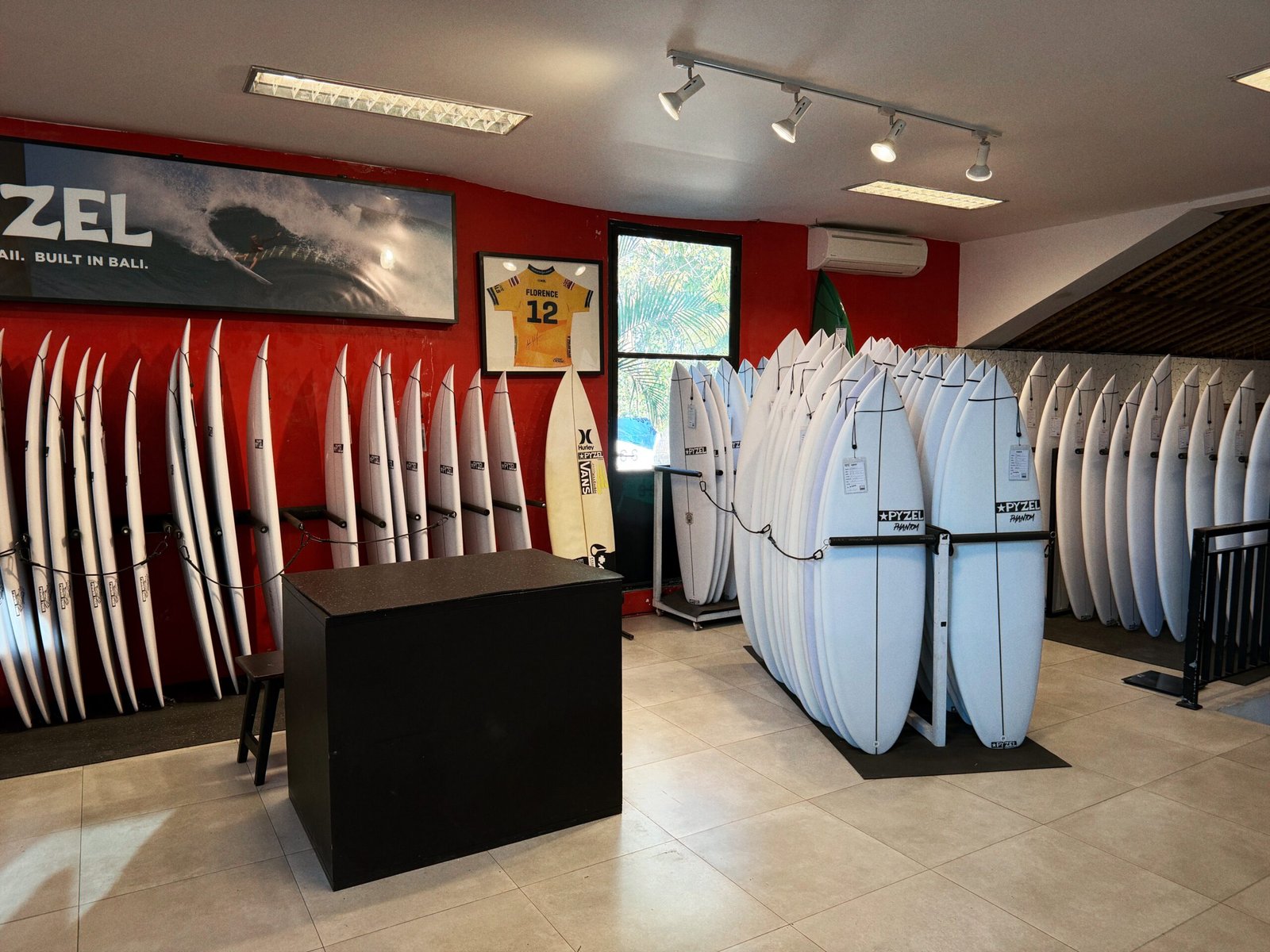
In established surf destinations, particularly Bali, surfboard rentals are easy to find. You can rent something for a single session, a few days, or longer, depending on where you are staying.
For a casual surf trip, that can be much simpler than flying with your own equipment. You arrive. You choose a board. You surf. No oversized baggage carousel required.
Bali Is Easy. Remote Indonesia Is Different.
This is probably the biggest distinction.
If you are staying in one of Bali’s main surf areas, you will generally have plenty of options. Surf shops, rental businesses, surf schools, and camps carry everything from beginner soft-tops to shortboards and longboards. If the board does not feel right, you may even be able to swap it for something else.
Once you travel farther from the main surf centers, your options can become much more limited. A destination may technically have surfboard rentals, but that does not mean it will have the board you want. There may be three boards available. One is too small. One has been repaired approximately seventeen times. And someone else rented the good one yesterday.
If you are traveling somewhere remote specifically to surf, do not build your entire trip around the assumption that the perfect board will be waiting for you when you arrive. It probably will not be.
Think About What Kind of Waves You Will Be Surfing
Your destination should influence your decision.
A beginner spending a week learning to surf in Kuta does not need to fly across the world with a soft-top. Renting is the obvious choice. An intermediate surfer staying around Bali’s main surf areas can also rent relatively easily, particularly if they are flexible about what they ride. But if you are traveling for a particular wave or a serious swell, bringing your own equipment becomes more important.
Indonesia can ask a lot from a surfboard. Shallow reefs, powerful waves, long paddle-outs, and heavier conditions can quickly expose a board that is wrong for the job. If you know you need a particular amount of volume, a step-up, a bigger board, or something made for more powerful surf, bring it.
Bringing a Board Bag Can Get Expensive
The cost of flying with surfboards varies enormously between airlines. Some airlines include surfboards within your checked baggage allowance. Others charge oversized baggage fees. Weight limits, length restrictions, and policies can also vary by airline, route, and aircraft type. And your journey may involve more than one airline. A board bag that is accepted on your international flight may become an expensive problem on a domestic connection.
Before flying, check each airline’s current baggage policy on your itinerary. Do not assume that because you have flown with a particular airline before, the rules are still the same. Also remember that getting to Indonesia is only the beginning. Cars, ferries, speedboats, domestic flights, and motorbikes are all part of surf travel here. A large board bag can turn a simple transfer into a logistical exercise surprisingly quickly.
But Renting Can Add Up Too
Renting often looks cheaper at first. For a day or two, it usually is. Over several weeks, the calculation can change. Daily rental costs add up, particularly if you want a higher-performance board rather than a basic rental. You may also need to leave a deposit or pay for damage if the board comes back with a new ding.
If you are planning to surf almost every day for a month, bringing your own board may make more financial sense. The longer the trip, the more useful it is to compare the total cost rather than simply looking at the price of one day’s rental.
There Is Another Option: Buy a Board in Indonesia
If you are staying for a while, you do not necessarily have to choose between bringing a board and renting one. You can buy one here. Indonesia has a well-established surf industry, particularly in Bali. There are local shapers, international surfboard brands, surf shops, and a healthy secondhand market. For a longer stay, buying a used board and selling it before you leave can sometimes make more sense than renting for weeks. It can also be an opportunity to order a board from a local shaper.
You may leave Indonesia with one more board than you arrived with. This happens.
If You Bring Boards, Bring More Than One
If you are traveling to Indonesia specifically to surf, bringing a small quiver is usually smarter than relying on a single board. Boards break. Reefs happen. And the waves you imagined when booking the trip may not be the waves you actually get.
A practical quiver depends on your ability, destination, and the season, but having at least two boards gives you some insurance if one gets damaged. It also gives you options when the conditions change. That does not mean you need to arrive with six boards. Pack for the waves you are realistically going to surf, not the surfer you imagine becoming after three days in Indonesia.
Pack Your Boards Properly
Airlines are not known for handling surfboards with the tenderness surfers would prefer.
If you are bringing your own boards, take the time to pack them properly. Remove the fins. Protect the nose and tail. Add padding around the rails. Do not leave loose objects inside the bag where they can move around and damage the boards. And give yourself enough time at the airport. Oversized baggage rarely makes anything faster.
Even with careful packing, damage can happen. Carry a small repair kit if you are heading somewhere remote, or find out beforehand whether there is a ding repair service near your destination. In Bali, getting a board repaired is generally straightforward. On a small island several hours from the nearest major town, it may be a different story.
So, Should You Bring a Surfboard to Indonesia?
If you are coming to Indonesia primarily to surf, especially if you are heading somewhere remote or chasing serious waves, bring your own boards. The familiarity and reliability are worth the inconvenience of traveling with them.
If you are visiting Bali, surfing casually, learning to surf, or combining surfing with a longer trip around Indonesia, renting can be the easier option.
And if you are staying for several weeks or months, buying a board locally may be worth considering.
There is no single answer.
Think about where you are going, what you want to surf, how long you are staying, and how upset you will be if the only rental board available is six inches shorter than what you normally ride.
Sometimes traveling light is worth it. Sometimes the board bag is part of the trip.